
A telephone rings. The caller sounds professional, knowledgeable, and concerned.
Something is supposedly wrong with your bank account. Someone has stolen your identity. Your savings are in danger. You must act immediately.
The caller explains how to protect your money. Perhaps you need to withdraw cash from your bank. Maybe you must deposit that money into a cryptocurrency machine at a nearby store.
It’s a carefully constructed deception. Unfortunately, people have lost thousands of dollars, sometimes much more, by following these instructions.
Scammers rely on fear, urgency, and persuasion. They may spend considerable time on the telephone building trust before convincing someone to transfer money.
Knowing when to stop, hang up, and independently verify a caller’s identity could protect someone’s life savings.
Financial Scams Can Threaten a Lifetime of Savings
Financial fraud affects people of all ages. However, older adults can face especially devastating consequences when criminals persuade them to withdraw retirement funds or transfer substantial savings.
According to the Federal Trade Commission’s October 2026 report, Americans aged 60 and older reported approximately $3 billion in fraud losses during 2025. That’s roughly five times the amount reported in 2020.
The FBI has also documented a growing problem involving cryptocurrency ATMs, sometimes called Bitcoin ATMs or cryptocurrency kiosks.
Its 2025 cryptocurrency kiosk fraud statistics identified more than 13,400 complaints involving these machines, with reported losses exceeding $388 million.
In these schemes, criminals may impersonate bank representatives, government officials, or technical support employees.
The caller creates an urgent problem and offers a seemingly reassuring solution.
That solution might involve withdrawing cash and depositing it into a cryptocurrency kiosk using instructions supplied by the criminal.
The money is then sent to a cryptocurrency wallet controlled by the scammer.
Understanding how these scams work is an important first step toward avoiding them.
Real-Life Scams Show Why Simple Warnings Matter
Fraud isn’t merely a theoretical risk. Recent incidents demonstrate how criminals exploit trust, fear, and the appearance of authority to steal substantial savings.
Florida Woman Loses $18,400 to Fake FBI Agents
In October 2026, an 82-year-old woman in Windermere, Florida, was contacted by scammers impersonating FBI agents.
They convinced her that they were investigating bank fraud and arranged for a supposed courier to collect money from her home.
The woman handed over a shoebox containing $18,400.
WFTV reported the incident, including a warning from local police about criminals posing as law enforcement officers.
New York Man Recognizes a Scam Before Surrendering $20,000
A different incident in Baldwin, New York, illustrates the importance of recognizing warning signs.
In September 2026, a 68-year-old man received a computer message claiming his device had been compromised.
He called the telephone number displayed on his screen. The person answering instructed him to withdraw $20,000 to supposedly protect his money.
The man withdrew the funds but became suspicious before handing them over. He contacted police, who subsequently arrested a suspect.
The Nassau County Police Department described the incident and encouraged residents to remind vulnerable family members about financial scams.
This case illustrates a particularly important lesson: Recognizing a scam before transferring money can prevent a devastating financial loss.
Retired Nurse Loses Nearly $400,000
Another heartbreaking example involves Mary Ellen Strange, a retired nurse from Indiana.
Her ordeal began with an unexpected contact concerning a supposed Amazon purchase. Scammers then impersonated authorities and persuaded her to cooperate with a fabricated investigation.
Over several weeks, the criminals convinced her to surrender substantial savings through various payment methods.
She ultimately lost nearly $400,000.
Strange later began sharing her experience to help others recognize similar schemes. PBS featured her story.
These cases share a disturbing pattern. Criminals invent an emergency, impersonate someone trustworthy, and pressure their victims to act before seeking independent advice.
Three Red Flags of a Financial Scam
Although fraudsters use different stories and techniques, many scams share recognizable warning signs.
Learning to identify these red flags can help people interrupt suspicious conversations before losing money or revealing sensitive information.
1. Demands for Money
Never withdraw cash, buy gold, purchase gift cards, or use a Bitcoin ATM because an unexpected caller tells you to.
Scammers may claim your savings are in danger or that transferring money is necessary to prevent an arrest, resolve an investigation, or protect an account.
The Federal Trade Commission warns about Bitcoin ATM scams in which criminals convince victims to deposit money into cryptocurrency kiosks.
Never move money into a supposedly “safe” account because an unexpected caller instructs you to do so.
2. Pressure and Secrecy
Hang up if someone demands immediate action, asks for passwords or verification codes, or tells you to keep a transaction secret.
Criminals frequently use threats and artificial deadlines to discourage victims from thinking carefully or consulting others.
A caller who insists that you remain on the telephone while withdrawing money is giving you another reason to be suspicious.
You have every right to end a conversation and verify the situation independently.
3. Impersonators
Scammers may pretend to represent your bank, law enforcement, government officials, or even a loved one.
They can sound knowledgeable, use official-sounding titles, and possess enough personal information to appear convincing.
Four additional precautions are especially important:
a) Beware of AI-Generated Voices. Scammers can use artificial intelligence to imitate a loved one’s voice. Hearing a familiar voice is no longer reliable proof of identity.
b) Create a Family Code Word. Agree on a private word or phrase that family members can use during unexpected emergencies. Keep it confidential, and independently verify unusual requests even when someone knows the code word.
c) Verify Calls From Law Enforcement. Be suspicious of callers claiming you face arrest, an outstanding warrant, or punishment for missing jury duty. Hang up and independently find the official telephone number for the agency or court.
d) Never Trust a Callback Number Supplied by a Suspicious Caller. A scammer could provide a telephone number answered by an accomplice pretending to be an agency employee. Find the official number yourself through a trusted source.
Remember that caller ID can also be falsified. A telephone number appearing to belong to a legitimate organization does not prove who is calling.
When in Doubt, Hang Up!
Call your bank, loved one, or government agency using a telephone number you independently find and verify.
Don’t use the number supplied by a suspicious caller. Don’t rely solely on caller ID, a familiar voice, or an official-sounding title.
If someone claims a family member is in trouble, contact that person directly using a number you already know. You can also speak with another trusted family member before taking action.
If you believe you’ve already been victimized, contact your financial institution promptly and report the incident to the appropriate authorities.
The Federal Trade Commission accepts reports at ReportFraud.ftc.gov.
Adults aged 60 and older who have experienced fraud can also contact the National Elder Fraud Hotline at 1-833-FRAUD-11 for assistance.
Keeping Fraud-Prevention Reminders Close at Hand
Businesses and community organizations regularly publish fraud alerts on their websites, send warning emails, and share safety tips.
Those efforts are important. But warnings may be forgotten or unavailable at the very moment someone receives a suspicious telephone call.
A refrigerator magnet offers a simple way to keep essential safety reminders visible in the home.
A custom fraud-prevention magnet could display the three warning signs, the sponsoring organization’s contact information, and trusted fraud-reporting resources.
For example, the magnet pictured below illustrates how brief warnings can be organized into a convenient household reference.
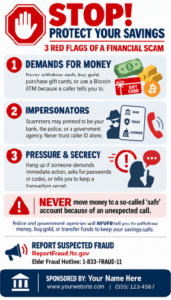
The pictured design is an example. Organizations can customize the warnings, reporting resources, branding, and contact information for their intended audience.
Unlike a dated calendar, a fraud-prevention reference magnet may remain useful for years. Its information should still be reviewed periodically to reflect new scam techniques and changes in contact details.
Who Could Distribute Fraud-Prevention Magnets?
Credit Unions and Community Banks
Financial institutions can provide magnets to members and customers as part of their fraud-prevention education programs.
A magnet might include the institution’s fraud-reporting telephone number, warning signs, and a QR code linking to additional consumer protection resources.
It could be included with an account-opening package, mailed to existing members, or distributed during community events.
Insurance Agencies and Mutual Insurance Companies
Insurance professionals often maintain long-term relationships with policyholders.
A fraud-prevention magnet could reinforce that relationship while providing reminders about suspicious telephone calls, identity theft, and financial scams.
The agency’s name, website, and telephone number can remain visible alongside the safety advice.
Real Estate Agents and Senior Relocation Specialists
Real estate agents who work with seniors, retirees, and their families could use fraud-prevention magnets as a thoughtful community outreach tool.
A customized magnet could include scam warnings alongside the agent’s photograph, name, brokerage affiliation, and contact information. Additional disclosures required by state real estate advertising regulations could also be incorporated.
Agents could distribute these magnets at open houses, community events, home consultations, or through their own mailings.
Senior Centers and Retirement Communities
Senior-service organizations could distribute magnets during educational programs, community meetings, or resident events.
A magnet featuring large, readable lettering and carefully selected warnings may be especially appropriate for older recipients.
Family members and caregivers could also use the information when discussing financial safety.
Healthcare Providers and Pharmacies
Healthcare organizations and pharmacies frequently communicate with older adults and their families.
Fraud-prevention magnets could raise awareness about callers who impersonate Medicare representatives, healthcare providers, insurance companies, or government agencies.
Community and Membership Organizations
Churches, nonprofit organizations, neighborhood associations, and other membership groups could distribute magnets during outreach campaigns or community safety programs.
These organizations can help reinforce fraud-prevention information while making trustworthy resources easier to find.
A Custom Magnet Can Reinforce These Important Warnings
No single educational tool can prevent every scam. However, frequently seeing a reminder to hang up and verify suspicious requests could help someone make a safer decision.
Custom fraud-prevention magnets offer organizations one way to support consumer education while keeping useful reference information available in the home.
Organizations can distribute magnets directly to customers and members or incorporate them into broader community outreach programs.
For those interested in reaching households by mail, Schedule Magnet also offers a direct-mail magnet program that combines a removable magnet with a full-color postcard.
The postcard can carry a detailed educational message, while the attached magnet provides a lasting reminder of the most important safety precautions.
Interested in a customized fraud-prevention magnet for your organization? We can help develop an appropriate format featuring your chosen safety messages, branding, and contact information.